Problem Solving Skills
Summary of Strategies
In this exercise, you were given a scenario in which there was a problem with a component you were creating on a CNC machine. You were then asked how you wanted to proceed. Depending on your path through this exercise, you might have found an easy solution and fixed it yourself, asked for help and worked with your trainer, or discovered an ongoing G-code problem that was bigger than you initially thought.
When issues and problems arise, it is important that they are addressed in an efficient and timely manner. Communication is an important tool because it can prevent problems from recurring, avoid injury to personnel, reduce rework and scrap, and ultimately, reduce cost, and save money. Although, each path in this exercise ended with a description of a problem solving tool for your toolbox, the first step is always to identify the problem and define the context in which it happened.
There are several strategies that can be used to identify the root cause of a problem. Root cause analysis (RCA) is a method of problem solving that helps people answer the question of why the problem occurred. RCA uses a specific set of steps, with associated tools like the “5 Why Analysis" or the “Cause and Effect Diagram,” to identify the origin of the problem, so that you can:
- Determine what happened.
- Determine why it happened.
- Fix the problem so it won’t happen again.
Once the underlying cause is identified and the scope of the issue defined, the next step is to explore possible strategies to fix the problem.
If you are not sure how to fix the problem, it is okay to ask for help. Problem solving is a process and a skill that is learned with practice. It is important to remember that everyone makes mistakes and that no one knows everything. Life is about learning. It is okay to ask for help when you don’t have the answer. When you collaborate to solve problems you improve workplace communication and accelerates finding solutions as similar problems arise.
One tool that can be useful for generating possible solutions is brainstorming. Brainstorming is a technique designed to generate a large number of ideas for the solution to a problem. The method was first popularized in 1953 by Alex Faickney Osborn in the book Applied Imagination. The goal is to come up with as many ideas as you can, in a fixed amount of time. Although brainstorming is best done in a group, it can be done individually.
Depending on your path through the exercise, you may have discovered that a couple of your coworkers had experienced similar problems. This should have been an indicator that there was a larger problem that needed to be addressed.
In any workplace, communication of problems and issues (especially those that involve safety) is always important. This is especially crucial in manufacturing where people are constantly working with heavy, costly, and sometimes dangerous equipment. When issues and problems arise, it is important that they be addressed in an efficient and timely manner. Effective communication is an important tool because it can prevent problems from recurring, avoid injury to personnel, reduce rework and scrap, and ultimately, reduce cost and save money.
One strategy for improving communication is the huddle. Just like football players on the field, a huddle is a short meeting with everyone standing in a circle. A daily team huddle is a great way to ensure that team members are aware of changes to the schedule, any problems or safety issues are identified and that team members are aware of how their work impacts one another. When done right, huddles create collaboration, communication, and accountability to results. Impromptu huddles can be used to gather information on a specific issue and get each team member's input.
To learn more about different problem solving strategies, choose an option below. These strategies accompany the outcomes of different decision paths in the problem solving exercise.
Root Cause Analysis

Root cause analysis (RCA) is a method of problem solving that identifies the underlying causes of an issue. Root cause analysis helps people answer the question of why the problem occurred in the first place. RCA uses clear cut steps in its associated tools, like the "5 Whys Analysis" and the "Cause and Effect Diagram," to identify the origin of the problem, so that you can:
- Determine what happened.
- Determine why it happened.
- Fix the problem so it won’t happen again.
RCA works under the idea that systems and events are connected. An action in one area triggers an action in another, and another, and so on. By tracing back these actions, you can discover where the problem started and how it developed into the problem you're now facing. Root cause analysis can prevent problems from recurring, reduce injury to personnel, reduce rework and scrap, and ultimately, reduce cost and save money.
There are many different RCA techniques available to determine the root cause of a problem. These are just a few:
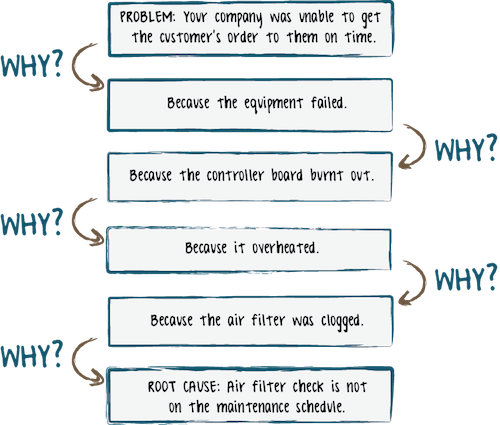
The 5 Whys Analysis technique involves repeatedly asking the question "Why?" and peeling away the layers of symptoms, leading to the root cause. Often, the answer to one question will lead you to another question. Although this technique is called "5 Whys," you may find that you will need to ask only 3 "Whys" or even 7 "Whys" before you find the core issue behind a problem.
How Huddles Work

Communication is a vital part of any setting where people work together. Effective communication helps employees and managers form efficient teams. It builds trusts between employees and management, and reduces unnecessary competition because each employee knows how their part fits in the larger goal.
One tool that management can use to promote communication in the workplace is the huddle. Just like football players on the field, a huddle is a short meeting where everyone is standing in a circle. A daily team huddle ensures that team members are aware of changes to the schedule, reiterated problems and safety issues, and how their work impacts one another. When done right, huddles create collaboration, communication, and accountability to results. Impromptu huddles can be used to gather information on a specific issue and get each team member's input.
The most important thing to remember about huddles is that they are short, lasting no more than 10 minutes, and their purpose is to communicate and identify. In essence, a huddle’s purpose is to identify priorities, communicate essential information, and discover roadblocks to productivity.
Who uses huddles? Many industries and companies use daily huddles. At first thought, most people probably think of hospitals and their daily patient update meetings, but lots of managers use daily meetings to engage their employees. Here are a few examples:
- Brian Scudamore, CEO of 1-800-Got-Junk?, uses the daily huddle as an operational tool to take the pulse of his employees and as a motivational tool. Watch a morning huddle meeting .
- Fusion OEM, an outsourced manufacturing and production company. What do employees take away from the daily huddle meeting .
- Biz-Group, a performance consulting group. Tips for a successful huddle .
Brainstorming

One tool that can be useful in problem solving is brainstorming. Brainstorming is a creativity technique designed to generate a large number of ideas for the solution to a problem. The method was first popularized in 1953 by Alex Faickney Osborn in the book Applied Imagination . The goal is to come up with as many ideas as you can in a fixed amount of time. Although brainstorming is best done in a group, it can be done individually. Like most problem solving techniques, brainstorming is a process.
- Define a clear objective.
- Have an agreed a time limit.
- During the brainstorming session, write down everything that comes to mind, even if the idea sounds crazy.
- If one idea leads to another, write down that idea too.
- Combine and refine ideas into categories of solutions.
- Assess and analyze each idea as a potential solution.
When used during problem solving, brainstorming can offer companies new ways of encouraging staff to think creatively and improve production. Brainstorming relies on team members' diverse experiences, adding to the richness of ideas explored. This means that you often find better solutions to the problems. Team members often welcome the opportunity to contribute ideas and can provide buy-in for the solution chosen—after all, they are more likely to be committed to an approach if they were involved in its development. What's more, because brainstorming is fun, it helps team members bond.
Learn More
- Watch Peggy Morgan Collins, a marketing executive at Power Curve Communications discuss How to Stimulate Effective Brainstorming .
- Watch Kim Obbink, CEO of Filter Digital, a digital content company, and her team share their top five rules for How to Effectively Generate Ideas .
Importance of Good Communication and Problem Description

Communication is one of the most frequent activities we engage in on a day-to-day basis. At some point, we have all felt that we did not effectively communicate an idea as we would have liked. The key to effective communication is preparation. Rather than attempting to haphazardly improvise something, take a few minutes and think about what you want say and how you will say it. If necessary, write yourself a note with the key points or ideas in the order you want to discuss them. The notes can act as a reminder or guide during your meeting.
Tips for clear communication of an issue:
- Provide a clear summary of the problem. Start at the beginning, give relevant facts, timelines, and examples.
- Avoid including your opinion or personal attacks in your explanation.
- Avoid using words like "always" or "never," which can give the impression that you are exaggerating the problem.
- If this is an ongoing problem and you have collected documentation, give it to your supervisor once you have finished describing the problem.
- Remember to listen to what's said in return; communication is a two-way process.
Not all communication is spoken. Body language is nonverbal communication that includes your posture, your hands and whether you make eye contact. These gestures can be subtle or overt, but most importantly they communicate meaning beyond what is said. When having a conversation, pay attention to how you stand. A stiff position with arms crossed over your chest may imply that you are being defensive even if your words state otherwise. Shoving your hands in your pockets when speaking could imply that you have something to hide. Be wary of using too many hand gestures because this could distract listeners from your message.
The challenge of communicating in the workplace is learning how and when to share your ideas or concerns. If you need to tell your supervisor or co-worker about something that is not going well, keep in mind that good timing and good attitude will go a long way toward helping your case.
Like all skills, effective communication needs to be practiced. Toastmasters International is perhaps the best known public speaking organization in the world. Toastmasters is open to anyone who wish to improve their speaking skills and is willing to put in the time and effort to do so. To learn more, visit Toastmasters International .
Methods of Communication

Communication of problems and issues in any workplace is important, particularly when safety is involved. It is therefore crucial in manufacturing where people are constantly working with heavy, costly, and sometimes dangerous equipment. As issues and problems arise, they need to be addressed in an efficient and timely manner. Effective communication is an important skill because it can prevent problems from recurring, avoid injury to personnel, reduce rework and scrap, and ultimately, reduce cost and save money.
There are many different ways to communicate: in person, by phone, via email, or written. There is no single method that fits all communication needs, each one has its time and place.
In person: In the workplace, face-to-face meetings should be utilized whenever possible. Being able to see the person you need to speak to face-to-face gives you instant feedback and helps you gauge their response in their body language. Be careful of getting sidetracked in conversation when you need to communicate a problem.
Email: Email has become the communication standard for most businesses. It can be accessed from almost anywhere and is great for things that don’t require an immediate response. Email is a great way to communicate non-urgent items to large amounts of people or just your team members. One thing to remember is that most people's inboxes are flooded with emails every day and unless they are hyper vigilant about checking everything, important items could be missed. For issues that are urgent, especially those around safety, email is not always be the best solution.
Phone: Phone calls are more personal and direct than email. They allow us to communicate in real time with another person, no matter where they are. Not only can talking prevent miscommunication, it promotes a two-way dialogue. You don’t have to worry about your words being altered or the message arriving on time. However, mobile phone use and the workplace don't always mix. In particular, using mobile phones in a manufacturing setting can lead to a variety of problems, cause distractions, and lead to serious injury.
Written: Written communication is appropriate when detailed instructions are required, when something needs to be documented, or when the person is too far away to easily speak with over the phone or in person.
There is no "right" way to communicate, but you should be aware of how and when to use the appropriate form of communication for the situation. When deciding the best way to communicate with a co-worker or manager, put yourself in their shoes, and think about how you would want to learn about the issue. Also, consider what information you would need to know to better understand the issue. Use your good judgment of the situation and be considerate of your listener's viewpoint.
"Never try to solve all the problems at once — make them line up for you one-by-one.”
— Richard Sloma